How do you calculate BMR?
BMR is calculated with the Mifflin-St Jeor equation using sex, age, height, and weight.
Fitness Calculator
Estimate your basal metabolic rate using age, sex, height, and weight. Use it as a simple starting point for calorie planning and nutrition decisions.
Why use it
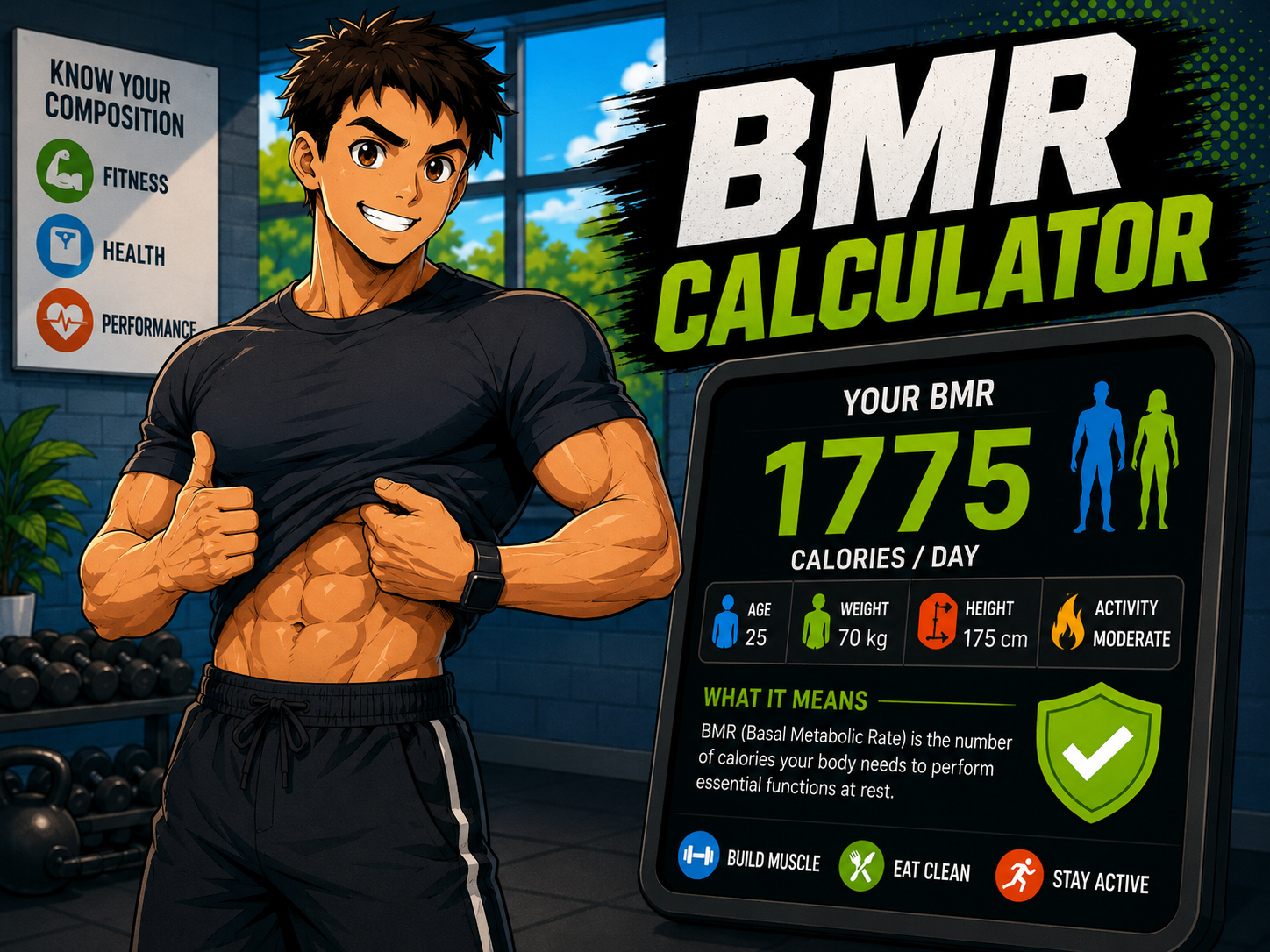
BMR tells you how many calories your body burns at rest. It does not include exercise, but it gives you a useful baseline for maintenance calories, fat loss, or muscle-gain planning.
Choose the unit system that matches the measurements you have.
Required. This calculator uses the Mifflin-St Jeor equation.
Required. Enter a whole number between 1 and 120.
Required. Enter your height in feet and inches.
Required. Enter your weight in pounds.
BMR stands for Basal Metabolic Rate. It estimates how many calories your body burns at rest to support basic functions like breathing, circulation, organ function, and cell repair.
Male: BMR = (10 x weight kg) + (6.25 x height cm) - (5 x age) + 5
Female: BMR = (10 x weight kg) + (6.25 x height cm) - (5 x age) - 161
US units first convert pounds to kilograms and inches to centimeters before applying the formula.
US example: Male, age 30, 5 ft 10 in, 175 lb.
Converted values: 79.4 kg and 177.8 cm.
Formula: BMR = (10 x 79.4) + (6.25 x 177.8) - (5 x 30) + 5 = 1,761 calories/day.
Metric example: Female, age 35, 165 cm, 65 kg gives a BMR of 1,345 calories/day.
BMR estimates calories burned at rest. TDEE, or Total Daily Energy Expenditure, adds your activity level, exercise, and daily movement on top of BMR.
Use your BMR as a baseline for planning a calorie deficit for weight loss, a maintenance target for stable weight, or a calorie surplus if you want to support muscle gain.
Age, sex, height, weight, muscle mass, body composition, activity level, and genetics all influence BMR. Health conditions and medications can also affect the result.
BMR calculators provide estimates, not exact measurements. Real calorie needs can vary based on metabolism, activity, muscle mass, health conditions, and how accurately you track inputs.
This calculator uses the Mifflin-St Jeor equation for a practical BMR estimate.
US inputs are converted to kilograms and centimeters before the equation is applied.
The final result is rounded to the nearest whole calorie per day.
Formula Guide
| Sex | Formula |
|---|---|
| Male | BMR = (10 x weight kg) + (6.25 x height cm) - (5 x age) + 5 |
| Female | BMR = (10 x weight kg) + (6.25 x height cm) - (5 x age) - 161 |
Frequently Asked Questions
BMR is calculated with the Mifflin-St Jeor equation using sex, age, height, and weight.
BMR means Basal Metabolic Rate. It estimates how many calories your body burns at rest to support basic functions.
No. BMR is calories burned at rest. Maintenance calories include BMR plus the calories you burn through daily activity.
BMR estimates calories burned at rest, while TDEE estimates total daily calories burned after adding activity level.
No. BMR does not include exercise. Exercise is part of your total daily energy expenditure, not your resting metabolic rate.
The formulas use different constants because average body composition and resting energy use often differ between men and women.
Yes. BMR can help you build a starting point for calorie deficit, maintenance, or surplus planning, though it is only one part of the picture.
This calculator provides a useful estimate, but actual calorie needs can vary based on metabolism, activity, muscle mass, health conditions, and tracking accuracy.